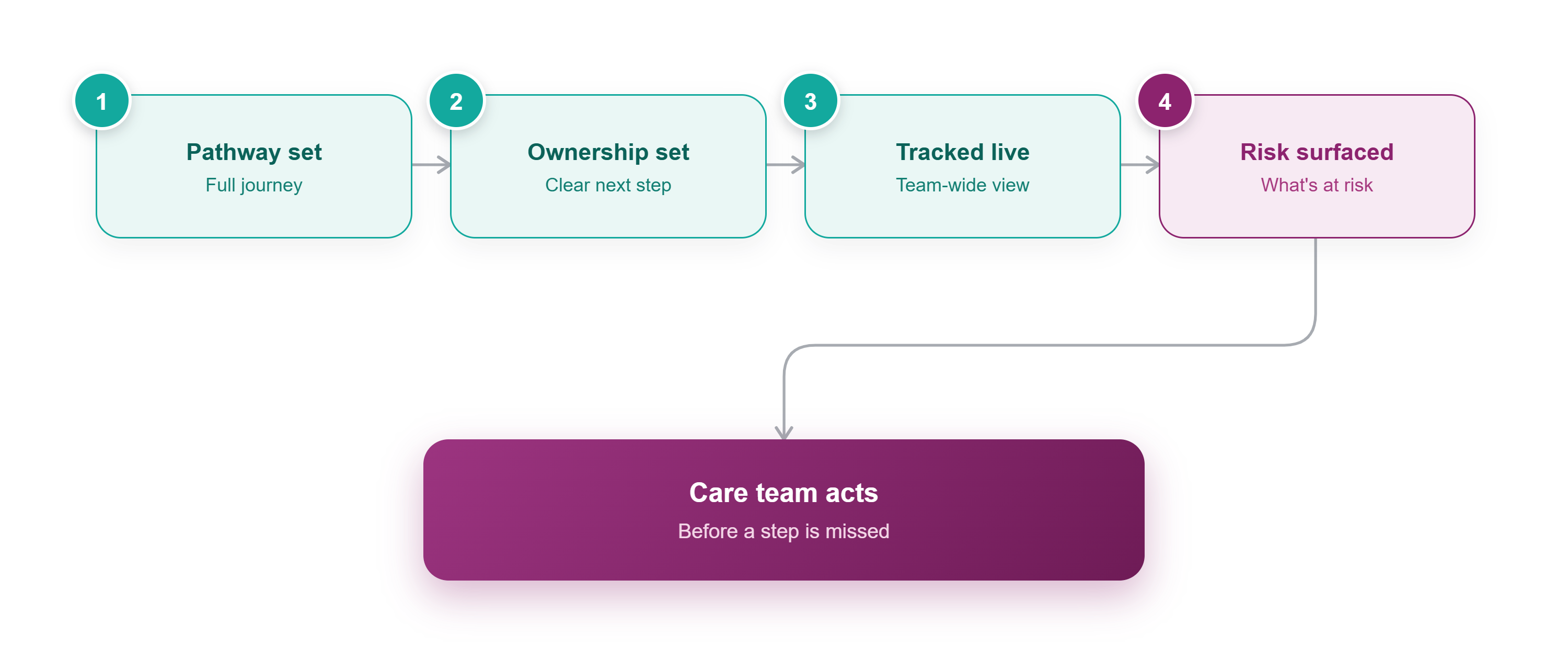
An Execution Layer for the Entire Cancer Care Journey

Coreo helps care teams track whether a cancer care plan is actually progressing — not just whether it was documented.

Why Coreo

Health systems have already invested in strong tools: EHRs to document care, portals to inform patients, and navigators to coordinate it all by hand. Each does its job — EHRs, in particular, were built primarily to support documentation, billing, and regulatory compliance, not to track whether a plan of care is actually being carried out in real time. None of them were built to answer a specific operational question: is this specific patient’s care plan progressing the way it was intended to, right now?

Coreo was built to answer exactly that question, and to do it inside the workflow care teams already use rather than asking them to adopt a new one.

Coreo is not:

  • A replacement for your EHR — it’s built to work alongside Epic and Cerner, with additional integrations planned
  • A separate patient app — Coreo integrates directly into the patient portal your health system already uses (e.g., MyChart), so patients see their care plan and next steps in a place they’re already checking — not in a new login they have to adopt
  • A generic project management or workflow tool — it’s built specifically around oncology care pathway logic, not generic task tracking
  • An autonomous decision-making system — Coreo is designed as clinical coordination and decision support, not a tool that makes treatment decisions

How Coreo Works

Care Pathway Orchestration

Physician orders, tumor board recommendations, and care milestones are translated into structured, longitudinal pathways spanning diagnosis, treatment, and survivorship — giving care teams a consistent structure instead of an informal, person-dependent process.

Closed-Loop Care Tracking

Coreo tracks clinical decisions from the point they’re made — an order, a referral, a tumor board recommendation — through to completion, so a step doesn’t quietly go unaddressed simply because no single person was explicitly watching it.

Multidisciplinary Coordination Workspace

Oncologists, primary care providers, and oncology nurse navigators share a common view of a patient’s care plan, responsibilities, and progress — reducing the reliance on side conversations, faxes, and informal follow-up to keep everyone aligned.

Oncology Nurse Navigator Support

Navigators get a consolidated view across their patient panel instead of piecing information together from multiple disconnected systems — designed to help navigators manage larger caseloads without losing visibility into any individual patient.

Cardio-Oncology Surveillance & Coordination

For patients receiving cancer therapies with known cardiovascular risk, Coreo helps support longitudinal monitoring coordination between oncology and primary care — an area where research shows meaningful gaps in follow-through today.

Among breast cancer survivors, cardiovascular disease has surpassed cancer itself as the leading cause of treatment-related death.1

Remote monitoring of a patient’s vital signs

Risk Signal Identification

Coreo is designed to surface coordination gaps — a stalled referral, an unconfirmed follow-up, a missed monitoring window — so care teams can intervene earlier rather than discovering a gap after it’s already affected a patient.

CIRRS: Coreo Intelligent Real-Time Risk Score

CIRRS is Coreo’s AI-driven framework for helping care teams identify which patients may need closer attention right now — and why.

AI-Driven Risk Scoring

CIRRS combines real-time patient and care coordination data using a machine learning model, trained on clinical, coordination, and workflow data, to help surface which patients may need earlier navigator review, follow-up, or intervention based on what’s currently known.

Predictive Risk Intelligence (In Development)

Coreo is advancing CIRRS toward predictive analytics, designed to identify patients approaching near-term risk of clinical escalation before it would be apparent from current-state signals alone — enabling more proactive, personalized care coordination.

Built to Work With the Systems You Already Have

Coreo is built on an EHR-agnostic architecture, with integrations currently built for Epic and Cerner, and additional EHR integrations planned as Coreo expands to new health systems. Coreo is designed around SMART on FHIR (HL7 FHIR R4) interoperability standards, and implementation includes formal data governance and security alignment with each partner’s requirements, including Business Associate Agreements where applicable. Coreo is evaluating intellectual property protection — including patents, trade secrets, and contractual safeguards — for core elements of its technology.
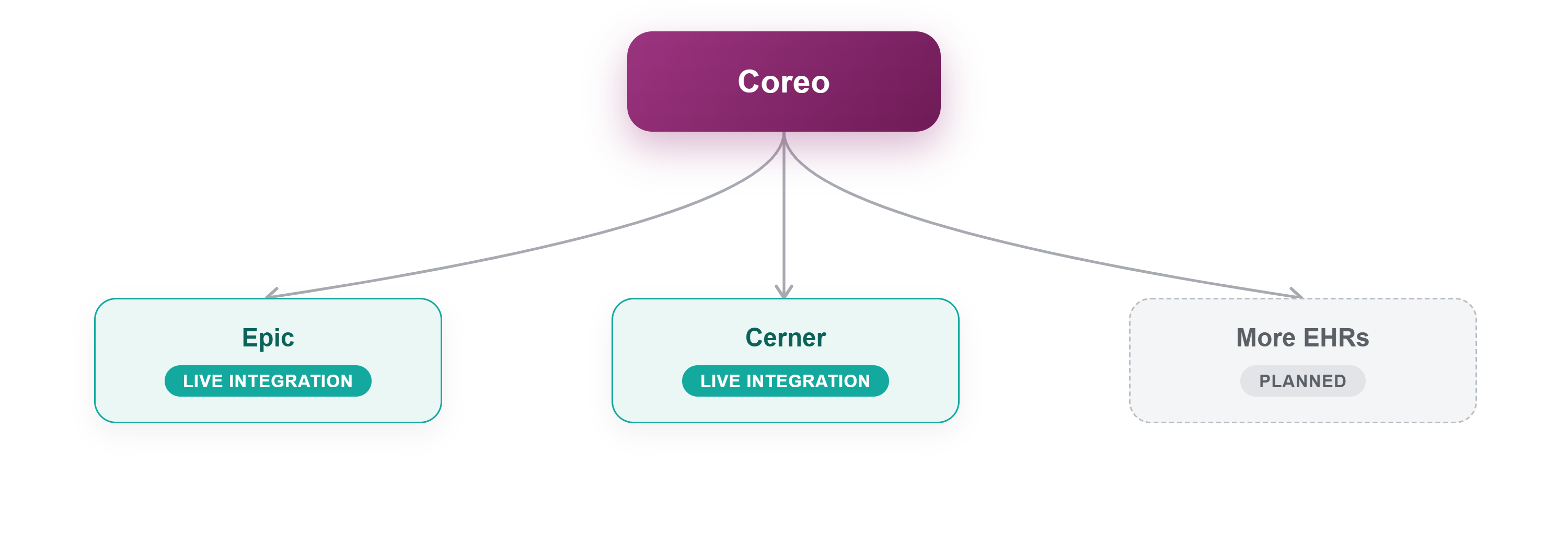
Coreo connects to Epic and Cerner as live integrations, with more EHRs planned.

Who Coreo Supports

Oncology Nurse Navigators

Cancer diagnoses are rising, and navigator caseloads are growing faster than the systems built to support them. Navigators are often left piecing together a patient’s status by hand across fragmented, disconnected EHRs and referral networks. Coreo consolidates that manual work into a single, clear view — giving navigators a faster path to knowing where to focus attention — without replacing their clinical judgment.

Oncology nurse navigator with a patient

Primary Care Providers & Oncologists

Coreo helps close the visibility gap that often excludes PCPs from a patient’s active cancer treatment. PCPs gain insight into treatment status relevant to managing comorbidities and long-term risk; oncologists gain a coordination layer that reduces time spent on manual follow-up so they can focus on complex, high-acuity care.

Primary care provider and oncologist reviewing a patient’s care

Patients

Patients see their care plan and next steps directly inside the patient portal they already use — no separate app, no new login — alongside continued support from their care team.

Patient reviewing their care plan on a laptop

References

  1. Klein, T. (2018, February). Heart failure more likely for some breast cancer and lymphoma survivors. Mayo Clinic News Network.