Cancer care plans don’t fail loudly. They fail silently.

Coreo is an AI-enabled, EHR-aligned oncology execution layer that helps care teams turn cancer care plans into completed, on-time, accountable action — not just documented intent.

Cancer care is planned in the EHR but executed across a fragmented web of orders, referrals, handoffs, and follow-up steps. Coreo helps close that gap by clarifying ownership, tracking care pathway progress, and surfacing what may be at risk of falling through — without replacing the systems care teams already use.

The Execution Gap

The Gap Between a Care Plan and a Completed Step

A cancer care plan is rarely delayed by a single failure. It’s delayed by dozens of small, distributed steps — an order that’s placed but not confirmed, a referral that’s sent but not scheduled, a follow-up that’s owned by no one in particular. Each one is minor on its own. Together, they add up to delay, and in oncology, delay has a measurable cost.

Physician walking through a hospital hallway
6–8%

Every 4-week delay in initiating cancer treatment is associated with a 6–8% increase in risk of death1

13%

For chemotherapy and radiation specifically, that risk rises to 13% per 4-week delay1

20–30%

Delays of 8 weeks or more are associated with a 20–30% higher risk of recurrence1

These aren’t outliers. They’re the predictable result of a system that documents care better than it tracks whether care happens.

Why This Isn’t Already Solved

More Than aDashboard. More Than aPortal. More Than aWorkflow Tool.

Health systems have invested heavily in EHRs, patient portals, and care coordination tools — and each of them plays a real role. But none of them were built to answer one specific question: is this care plan actually progressing the way it was intended to?

Clinical care team

EHRs are systems of record, generally built to support documentation, billing, and regulatory compliance — not to give care teams a coordinated, cross-disciplinary view of how a patient’s care is actually progressing. They capture what was ordered and documented, but not whether it was completed on time or who’s responsible for the next step.

Patient portals give patients a window into their own individual records, but they don’t aggregate a patient’s full cancer journey across the multiple providers and specialists involved — the way Coreo is designed to. Coreo integrates directly into the patient portal your health system already uses (e.g., MyChart), just as it integrates into your EHR (e.g., Epic), giving patients a connected view of their care, not just isolated pieces of it.

Generic workflow and task tools can track tasks, but they don’t understand oncology-specific care pathways, clinical risk context, or the sequencing that matters in cancer care.

Nurse navigators — the people closest to this problem — are often managing this manually, across disconnected systems, with caseloads that have outgrown the tools available to them.

Coreo isn’t a replacement for any of these. It’s the layer that sits across them, giving care teams a shared, real-time view of where a patient’s care stands — and helping clarify who owns what happens next.

How Coreo Works

An Execution Layer, Not Another System to Log Into

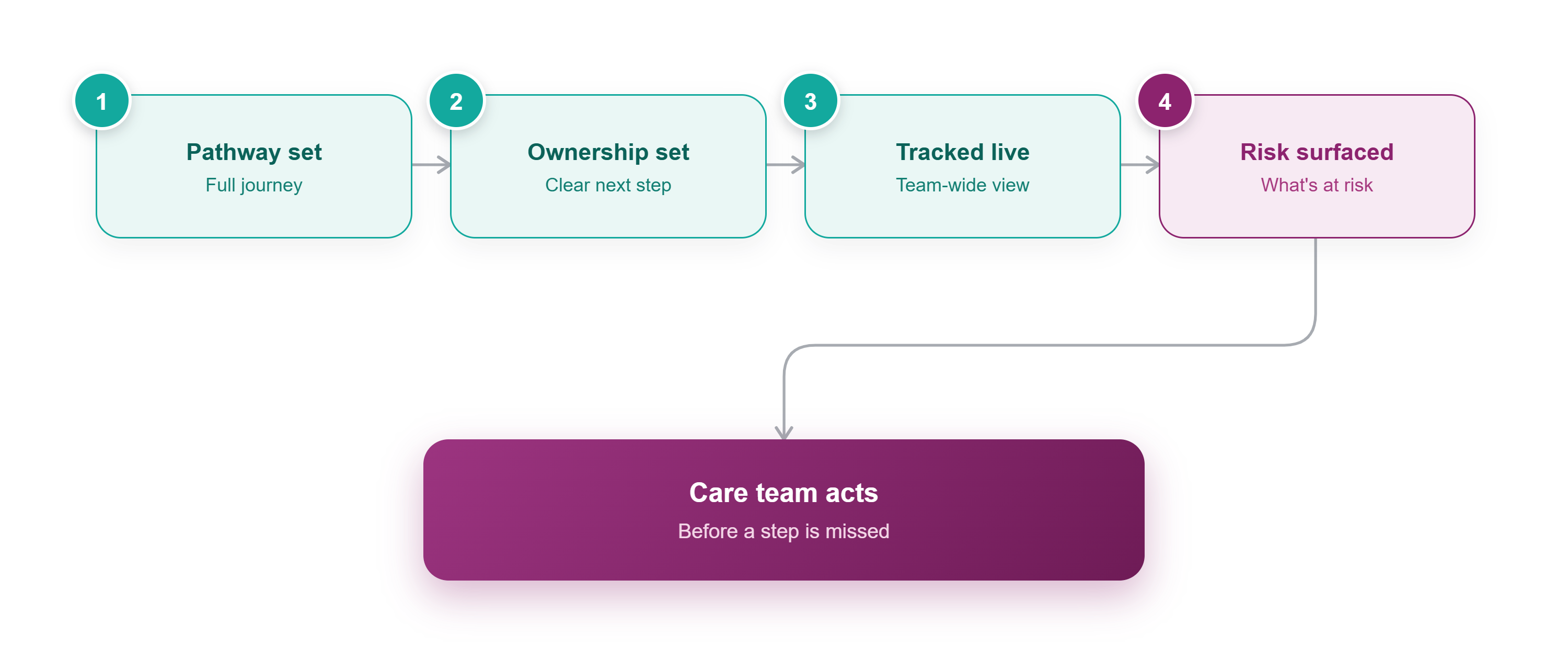
Coreo execution flow: pathway set, ownership set, tracked live, and risk surfaced — leading to the care team acting before a step is missed.

Coreo is built to work inside the systems care teams already use — not alongside them as one more login. It’s designed with an EHR-agnostic architecture, currently built for Epic and Cerner, with additional EHR integrations planned as Coreo expands.

  1. Care plans become trackable pathways.

    Physician orders, tumor board recommendations, and care milestones are translated into structured, longitudinal pathways spanning diagnosis, treatment, and survivorship.

  2. Ownership becomes visible.

    Instead of responsibility being informally distributed across oncologists, PCPs, and nurse navigators, Coreo helps clarify who owns each next step — and when it’s due.

  3. Progress — and gaps — become visible in real time.

    Care teams get a shared view of what’s on track and what may be at risk of falling through, so follow-up can happen earlier, not after a step has already been missed.

  4. AI-supported risk detection.

    As Coreo moves into pilot deployments, AI-driven analysis will help synthesize clinical, coordination, and patient-reported signals to flag which patients may need attention earliest — building on the machine learning–based prioritization framework already in place today.

Why Now

The Timing Isn’t Incidental

Oncology care coordination has been a known problem for years. What’s changed is the pressure to solve it:

  1. CMS now reimburses for patient navigation services under the 2024 Medicare Physician Fee Schedule2, creating a direct financial incentive to formalize coordination work that was previously informal and largely uncompensated.

  2. Value-based oncology models, including the Enhancing Oncology Model, tie reimbursement to documented coordination, timeliness, and outcomes — not just volume alone.

  3. Nurse navigator caseloads continue to outpace staffing, making manual, unassisted coordination increasingly difficult to sustain at scale.

Health systems are no longer asking whether care execution needs better infrastructure. They’re asking how to build it without adding burden to already-stretched teams.

Credibility

Built With Oncology Expertise, Not Just Software Expertise

Coreo’s clinical strategy is shaped by a medical advisory board grounded in oncology and cancer survivorship care, including:

Dr. Kevin Oeffinger

Founding Director, Duke Cancer Institute Center for Onco-Primary Care

Dr. Thomas LeBlanc

Chief Patient Experience & Safety Officer, Duke Cancer Institute

Allison Dimsdale, DNP, NP-C, AACC, FAANP

“It is crucial that the patient not get lost in the complexity of cancer care... RNs are perfectly trained and positioned to provide the holistic attention to keep these patients safe, informed and ultimately well.”

Allison Dimsdale, DNP, NP-C, AACC, FAANP Duke University School of Medicine
Venn diagram showing the three principal participants in oncology care — Primary Care Physician, At-Risk Patient, and Cancer Specialist — overlapping at the Oncology Nurse Navigator.
Team Snapshot

Led by Operators Who’ve Built and Scaled Healthcare Companies Before

Christie L. Clipper, DHA, is a healthcare executive with nearly 30 years of experience building and scaling healthcare organizations — from early-stage service businesses to system-level operations at Henry Ford Health and Duke University Medical Center. At Duke, she also worked with the Office of Technology and Commercialization to evaluate pathways for bringing care delivery innovations to market. Coreo is the direct result of that operating experience, paired with a firsthand understanding of what happens when cancer care coordination breaks down.

Origin Story

Why We Built Coreo

A personal look at the experience that shaped Coreo’s mission.

Segmented CTA

Let’s Talk

Providers

“Interested in piloting Coreo at your organization?”

Explore a Design Partnership

Investors

“Want to learn more about the opportunity?”

Request a Conversation

Technical & Clinical Collaborators

“Curious how Coreo integrates with your systems or workflow?”

Talk to Our Team

References

  1. Hanna TP, King WD, Thibodeau S, Jalink M, Paulin GA, Harvey-Jones E, et al. Mortality due to cancer treatment delay: systematic review and meta-analysis. BMJ. 2020;371:m4087. doi:10.1136/bmj.m4087
  2. Centers for Medicare & Medicaid Services. CMS Physician Payment Rule Advances Health Equity [Press Release]. July 2023.